

Looking for the Best Construction Company in Massachusetts? 7 Things to Check Before You Hire
Choosing a construction company for your home is a big decision. Whether you’re planning a kitchen remodel, bathroom renovation, basement remodeling project, home addition, or a complete home renovation, the contractor you hire can have a major impact on the final result.
If you’ve searched for the best construction company in Massachusetts, you’ve probably noticed there are plenty of contractors to choose from. The challenge isn’t finding a name—it’s figuring out which company is actually the right fit for your project.
As a general contractor, I’ve learned that homeowners shouldn’t choose a contractor based on price or a five-star rating alone. Good construction comes down to experience, communication, workmanship, planning, and having a clear understanding of what you’re paying for.
Before you sign a contract, here are seven things I recommend checking.
1. Check the Contractor’s Registration, Licensing, and Insurance
Before discussing colors, countertops, flooring, or project timelines, start with the basics.
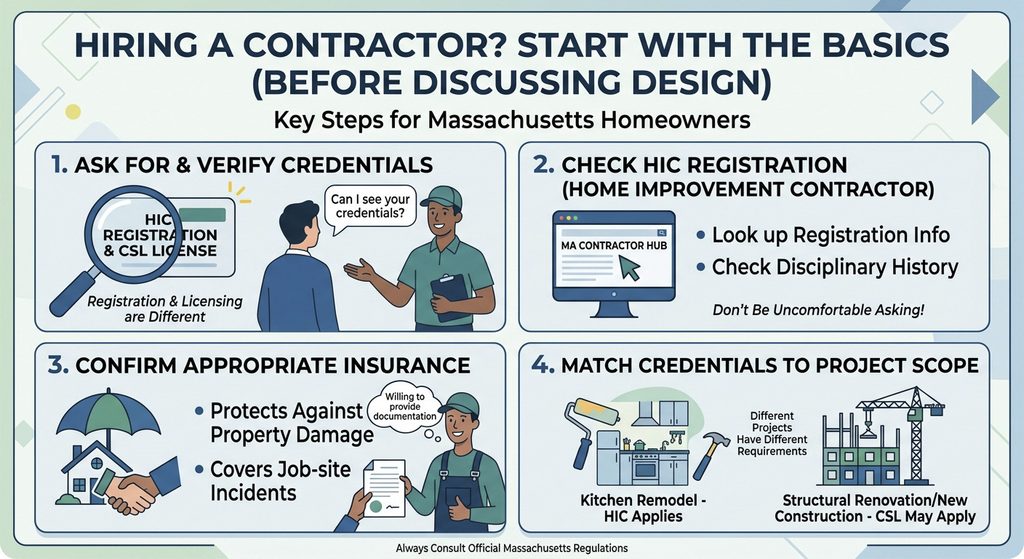
For many residential improvement projects in Massachusetts, contractors working on existing owner-occupied residential properties with one to four units are required to register as a Home Improvement Contractor (HIC). The Commonwealth also makes it clear that HIC registration and a Construction Supervisor License (CSL) are different credentials and aren’t interchangeable.
That means homeowners should ask questions about the contractor’s credentials before work begins.
Ask About HIC Registration
Massachusetts provides the MA Contractor Hub, where homeowners can look up contractor registration information and disciplinary history.
Don’t be uncomfortable asking a contractor for their registration information. A professional construction company should understand why you’re asking.
Ask About Insurance
You should also ask about appropriate insurance coverage. Depending on the project, this can help protect homeowners from potential problems involving property damage or job-site incidents.
A good contractor should be willing to explain their coverage and provide documentation when requested.
Remember That Different Projects Have Different Requirements
A kitchen remodel isn’t necessarily subject to exactly the same requirements as a structural renovation or new construction project.
For example, Massachusetts explains that a CSL is generally associated with work involving structural elements, while HIC registration applies to covered home improvement contracting work.
The important thing is to make sure the contractor has the appropriate credentials for the work being performed.
2. Look at Their Experience With Projects Like Yours
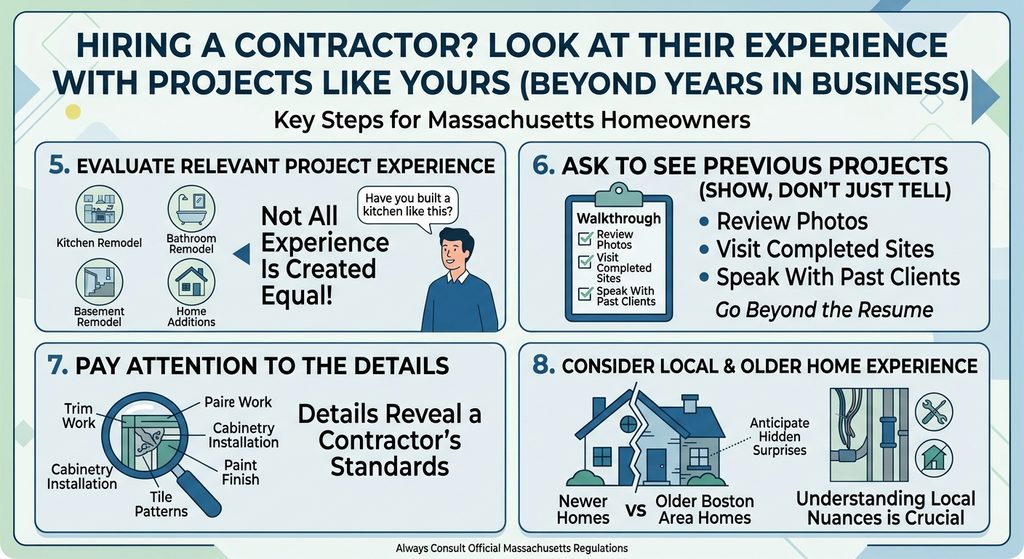
A contractor can have years of experience and still not be the right fit for your particular project.
If you’re planning a kitchen renovation in Massachusetts, look for a contractor who has completed kitchens similar to what you have in mind.
The same applies to:
- Bathroom remodeling
- Basement remodeling
- Attic remodeling
- Home additions
- Complete home remodeling
- Custom design-build projects
- New construction
- Deck construction
- Exterior improvements
Ask to See Previous Projects
Don’t just ask, “How long have you been in business?”
Ask to see actual work.
Look at photos of completed projects and, when possible, visit projects or speak with previous customers. Pay attention to details such as trim work, cabinetry installation, tile work, flooring transitions, paint finishes, and overall workmanship.
Those small details can tell you a lot about how a contractor approaches a project.
Local Experience Can Matter
Massachusetts has a mix of newer homes and older properties, particularly around communities in the Greater Boston area.
Older homes can come with surprises hidden behind walls, under floors, or above ceilings. An experienced contractor knows that remodeling isn’t always as simple as removing one thing and installing another.
That’s why experience isn’t just about how many projects a company has completed. It’s also about knowing how to respond when something unexpected comes up.
3. Read Reviews—But Look Beyond the Star Rating
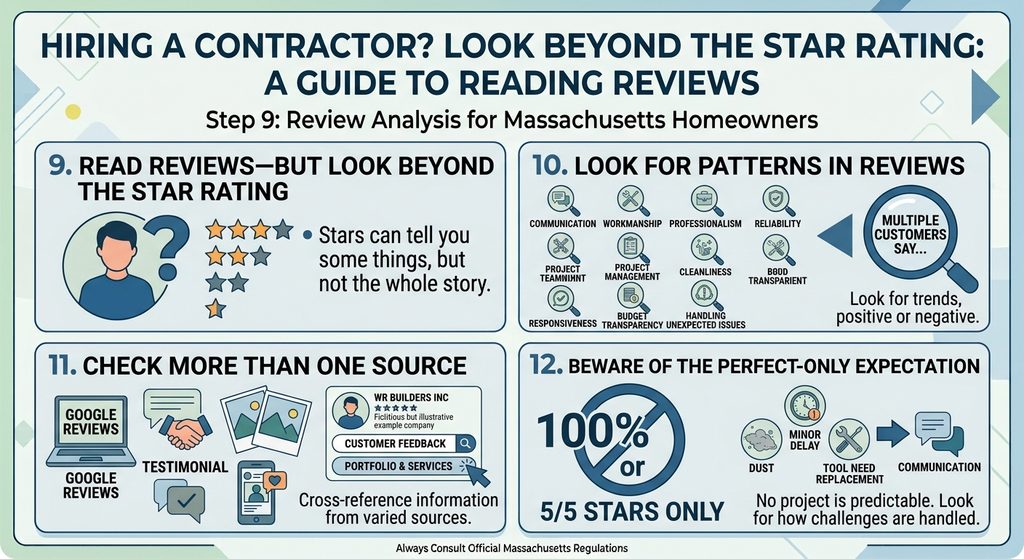
Reviews are useful, but don’t make your decision based on the number of stars alone.
When comparing construction companies in Massachusetts, read what previous customers actually say.
Look for Patterns in Reviews
Pay attention to comments about:
- Communication
- Workmanship
- Professionalism
- Reliability
- Project management
- Cleanliness
- Responsiveness
- Budget transparency
- Handling unexpected issues
If multiple homeowners mention the same positive or negative experience, that’s worth paying attention to.
Check More Than One Source
Look at Google reviews, testimonials, project photos, and other independent sources when available.
For example, homeowners considering a contractor such as WR Builders Inc can review the company’s customer feedback alongside its portfolio and services rather than relying on a single source.
The goal isn’t to find a contractor with perfect reviews. No construction project is completely predictable. Instead, look for evidence of consistent communication, quality work, and professional customer service.
4. Get Detailed Estimates From Multiple Contractors
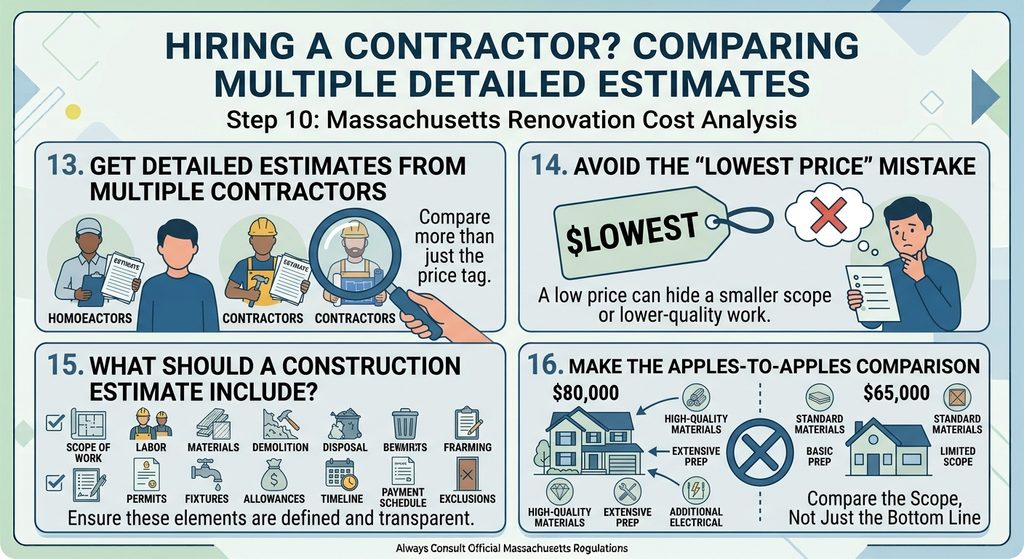
One of the most common mistakes homeowners make is choosing a contractor based entirely on the lowest estimate.
I understand why the lowest number is attractive. Remodeling and construction projects can be expensive.
But here’s the problem: two estimates can have completely different scopes of work.
One contractor might include demolition, disposal, higher-quality materials, detailed preparation, and finishing work, while another quote may leave some of those items out.
What Should a Construction Estimate Include?
Depending on your project, a detailed estimate should explain things such as:
- Scope of work
- Labor
- Materials
- Demolition
- Disposal
- Permits where applicable
- Fixtures and finishes
- Allowances
- Estimated timeline
- Payment schedule
- Potential exclusions
The more detailed the estimate, the easier it is to understand what you’re actually comparing.
Don’t Just Compare the Bottom Line
Suppose Contractor A quotes $80,000 and Contractor B quotes $65,000.
At first glance, Contractor B looks cheaper.
But what if the first estimate includes better materials, more extensive preparation, additional electrical work, and a larger scope?
The $15,000 difference may not be a real apples-to-apples comparison.
When comparing home renovation contractors in Massachusetts, compare the scope and specifications—not just the final number.
5. Find Out How the Contractor Communicates
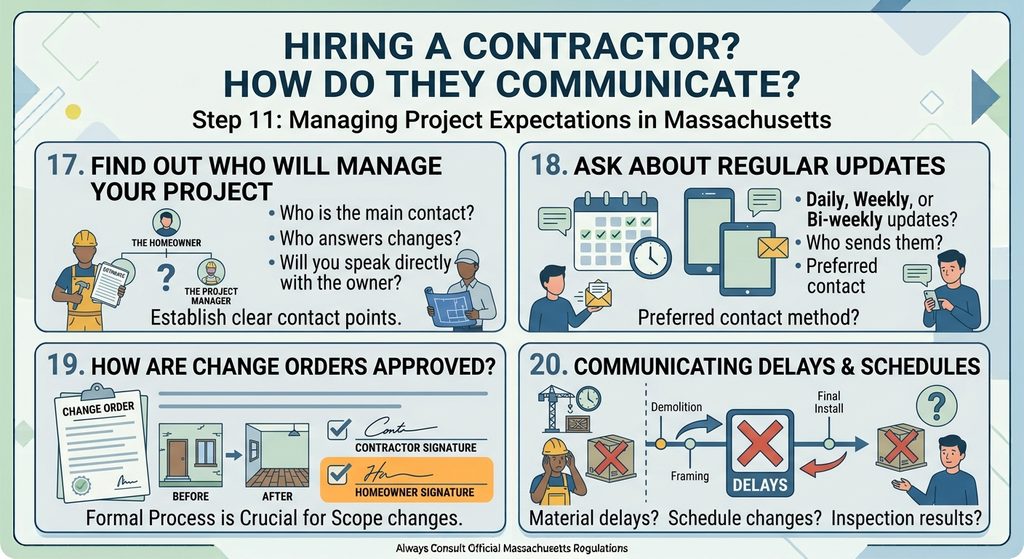
This is one of the biggest things I recommend homeowners think about before hiring a construction company.
Construction can be disruptive. There may be dust, noise, deliveries, inspections, subcontractors, and schedule changes.
Good communication makes the process much easier.
Ask Who Will Manage Your Project
Find out who your main point of contact will be.
Will you speak directly with the contractor? Will there be a project manager? Who will answer questions when something changes?
You should know this before construction begins.
Ask How You’ll Receive Updates
Every company has its own process, but you should have a clear understanding of how project updates will be handled.
For example:
- Will you receive regular progress updates?
- Who should you contact with questions?
- How are schedule changes communicated?
- How are material delays handled?
- How are change orders approved?
A good construction project isn’t only about building something correctly. It’s also about keeping the homeowner informed along the way.
6. Make Sure the Contract Clearly Defines the Work
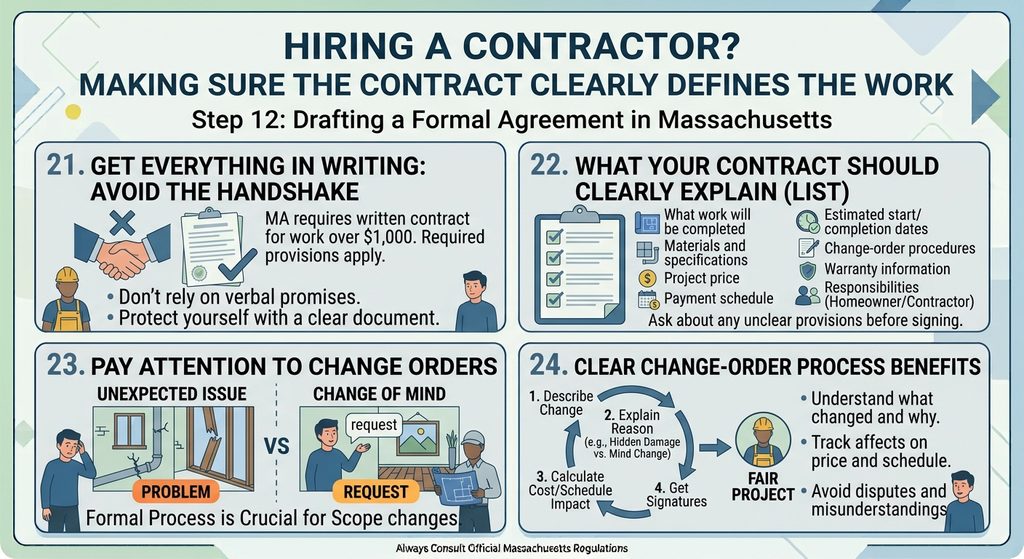
Never rely on a handshake or verbal promise for a major construction project.
Get everything important in writing.
Massachusetts has specific requirements for covered home improvement contracts. The state notes that work estimated at $1,000 or more generally requires a written contract containing required provisions.
Your Contract Should Clearly Explain:
- What work will be completed
- Materials and specifications
- Project price
- Payment schedule
- Estimated start date
- Estimated completion date
- Change-order procedures
- Warranty information
- Responsibilities of the homeowner
- Responsibilities of the contractor
If something is unclear, ask about it before signing.
Pay Attention to Change Orders
Unexpected issues can happen during remodeling.
For example, a contractor may open a wall and discover damaged framing or outdated plumbing. That’s different from changing your mind halfway through the project and requesting something completely different.
A clear change-order process helps everyone understand what changed, why it changed, and how it affects the price and schedule.
7. Look for Value—Not Just the Lowest Price
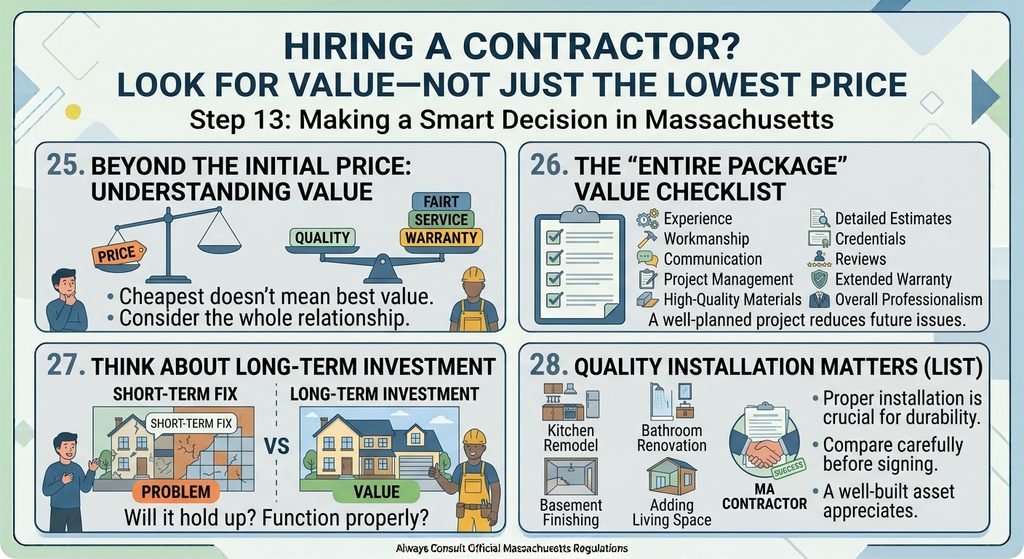
When homeowners ask me how to find the best construction company in Massachusetts, I always recommend looking beyond the initial price.
The cheapest contractor isn’t automatically the best value, just as the most expensive contractor isn’t automatically the best choice.
Look at the Entire Package
Consider:
- Experience
- Workmanship
- Communication
- Project management
- Materials
- Detailed estimates
- Credentials
- Reviews
- Warranty
- Overall professionalism
A contractor who takes the time to properly plan your project can help reduce avoidable problems later.
Think About Your Home as a Long-Term Investment
A renovation isn’t just about how your home looks on completion day.
You want the work to function properly and hold up over time.
Whether you’re remodeling a kitchen, finishing a basement, renovating a bathroom, or adding living space, quality installation matters.
That’s why it’s worth taking the time to compare contractors carefully before signing.
Questions to Ask Before Hiring a Massachusetts Construction Company
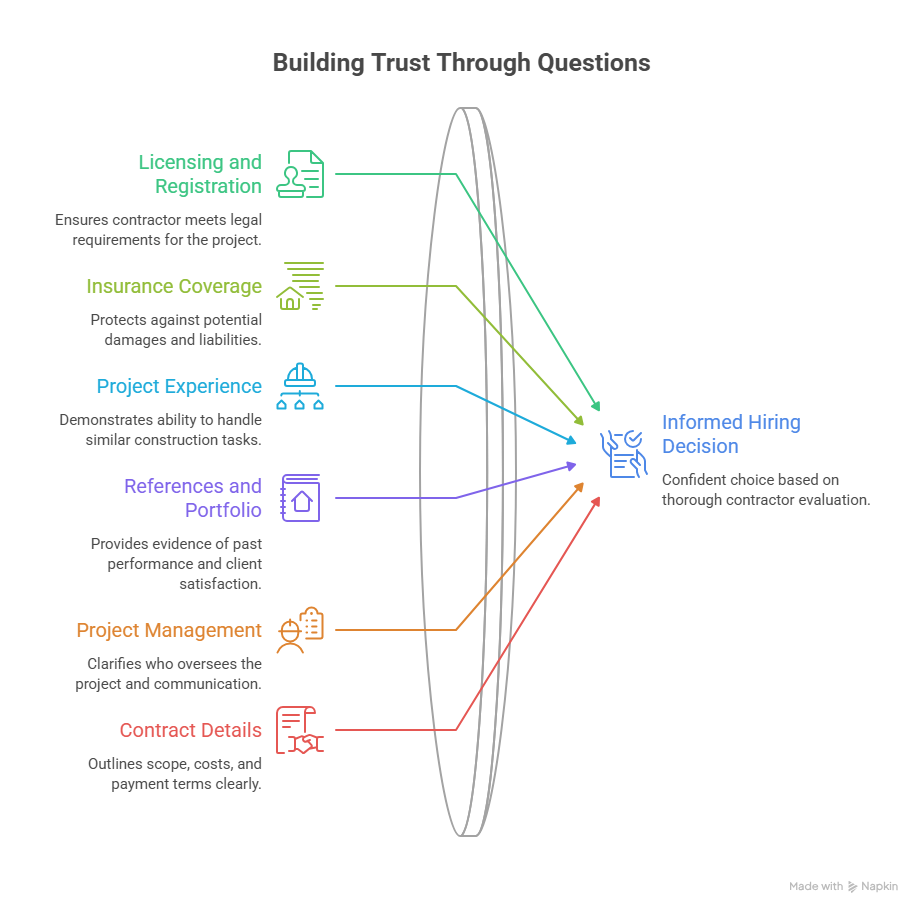
Before you hire a contractor, consider asking these questions:
- Are you registered as a Home Improvement Contractor if registration is required for my project?
- What other licenses or credentials apply to my project?
- Can you provide proof of insurance?
- Have you completed projects similar to mine?
- Can I see examples of your previous work?
- Can you provide references?
- Who will manage my project?
- What is included in my estimate?
- What isn’t included?
- How do you handle change orders?
- How will you communicate project updates?
- What happens if unexpected construction issues are discovered?
- What does the payment schedule look like?
- What warranty or workmanship coverage do you provide?
- What is the estimated project timeline?
A contractor who is willing to answer these questions clearly is giving you useful information before you make a major commitment.
Red Flags to Watch for When Hiring a Contractor
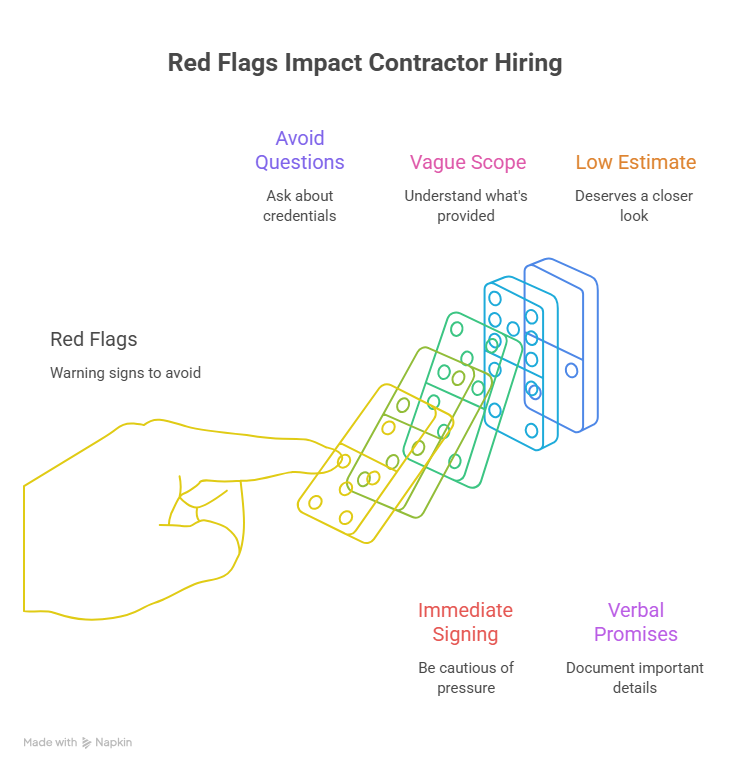
Even when you’re eager to start your project, don’t ignore warning signs.
An Estimate Is Far Lower Than Everyone Else
A significantly lower bid deserves a closer look.
Ask what is included and what isn’t.
You’re Being Pressured to Sign Immediately
Be cautious if someone insists that you must sign today or risk losing a deal.
Take the time you need to understand the proposal and contract.
The Scope of Work Is Vague
“Remodel kitchen” isn’t a very detailed scope of work.
For a major renovation, you want to understand what the contractor is actually providing.
Everything Is Based on Verbal Promises
Important details should be documented.
If a contractor promises something important, make sure it is included in the written agreement.
They Avoid Questions About Credentials
You should be able to ask reasonable questions about registration, licensing, insurance, experience, and references.
Massachusetts also provides homeowners with tools to check contractor registration and disciplinary information through the MA Contractor Hub.
Why Local Experience Matters When Building or Remodeling in Massachusetts
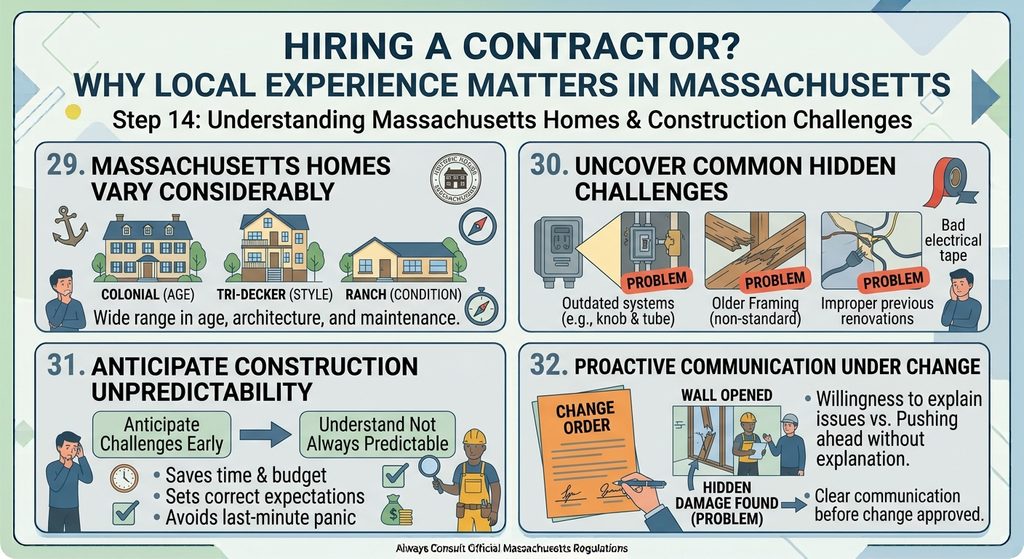
Massachusetts homes can vary considerably in age, construction style, and condition.
A remodeling contractor may encounter everything from older framing and outdated systems to previous renovations that weren’t completed properly.
Local experience can help a contractor anticipate some of these challenges.
It can also help homeowners understand that construction isn’t always predictable.
That’s why an experienced Massachusetts general contractor should be prepared to communicate when conditions change rather than simply pushing ahead without explaining the issue.
What Should You Look for in the Best Construction Company in Massachusetts?
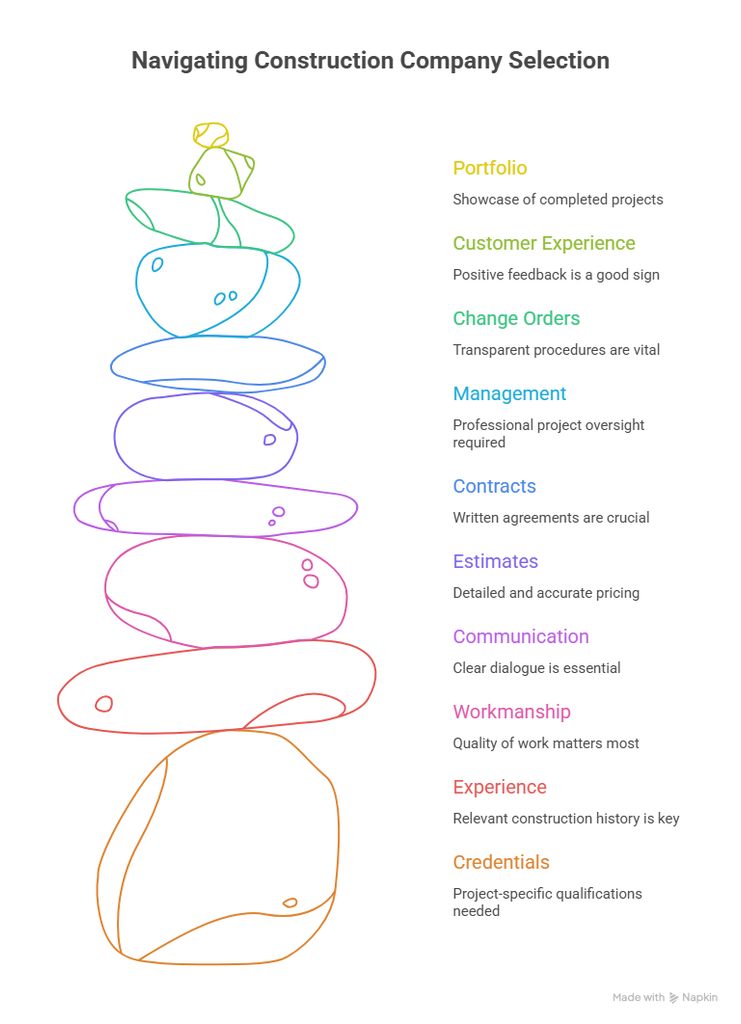
There’s no single checklist that guarantees a particular contractor will be right for every homeowner.
But there are several qualities worth looking for:
- Proper credentials for the project
- Relevant construction experience
- Strong workmanship
- Clear communication
- Detailed estimates
- Written contracts
- Professional project management
- Transparent change-order procedures
- Positive customer experiences
- A portfolio of completed work
Most importantly, choose a contractor whose approach fits the type of project you’re planning.
Ready to Start Your Massachusetts Construction Project?
Finding the best construction company in Massachusetts isn’t about choosing the first company you find or automatically accepting the lowest estimate.
Take your time.
Check credentials. Review previous work. Compare detailed estimates. Ask questions. Read customer reviews. Understand the contract. And make sure you feel comfortable with the people who will be working in your home.
If you’re planning a kitchen remodeling, bathroom remodeling, basement remodeling, attic renovation, home addition, complete home renovation, or new construction project in Massachusetts, WR Builders Inc. can help you discuss your project and understand the next steps.
Ready to talk about your project? Contact WR Builders Inc. to schedule a consultation and request an estimate.
Frequently Asked Questions
What should I look for in the best construction company in Massachusetts?
Look for relevant experience, proper credentials, insurance, quality workmanship, clear communication, detailed estimates, written contracts, and a strong track record of completed projects.
How do I know if a Massachusetts contractor is reliable?
Review their credentials, previous projects, customer reviews, references, communication process, and contract. Massachusetts homeowners can also use the MA Contractor Hub to look up contractor registration information and disciplinary history.
Should I choose the cheapest construction company?
Not necessarily. Compare the complete scope of work, materials, project management, timeline, and what’s included in each estimate. A lower initial price doesn’t always mean lower overall cost.
How many construction estimates should I get?
There’s no universal number that works for every project, but getting multiple detailed estimates can help you understand the expected scope and pricing. Make sure you’re comparing similar specifications rather than just comparing totals.
What should be included in a construction contract?
A contract should clearly describe the scope of work, materials, pricing, payment schedule, project timing, change-order procedures, and other applicable terms. Massachusetts has specific requirements for covered home improvement contracts.
What is the difference between HIC registration and a Construction Supervisor License?
They are different credentials. Massachusetts states that HIC registration and a CSL are not interchangeable, and whether one or both apply depends on the type and scope of work.
What types of projects can a Massachusetts general contractor handle?
Depending on the contractor’s qualifications and services, residential construction companies may handle projects such as kitchen remodeling, bathroom remodeling, basement remodeling, attic renovations, additions, complete home renovations, decks, and new construction.
How early should I contact a contractor before starting a renovation?
It’s generally a good idea to start the conversation well before you want construction to begin. Larger projects may require planning, design, estimating, material selection, scheduling, and permits, so giving yourself enough time can make the process much smoother.