
The Ultimate Guide to Home Transformations: From Dream Kitchens to Historic Restorations
Hey there, fellow homeowner. If you’re reading this, you’re probably staring at a dated kitchen cabinet, a cramped bathroom, or a historic living room that hasn’t seen an upgrade since the disco era, and you’re thinking: It’s time. As an experienced general contractor, I’ve seen it all. I’ve uncovered hidden 1920s knob-and-tube wiring, knocked down walls that structural engineers swore wouldn’t budge, and handed over keys to families standing in their absolute dream spaces.
Television makes home renovations look like a 45-minute miracle where the only obstacle is a minor disagreement over paint swatches. In the real world, a successful home transformation takes planning, patience, a healthy budget contingency, and the right team. Whether you are actively searching for the best residential remodeling services for kitchen renovations near me or trying to figure out if you need a design-build firm or a local carpenter, this guide is your boots-on-the-ground blueprint. Let’s dive in.
The Epicenter of the Home: Crafting the Dream Kitchen
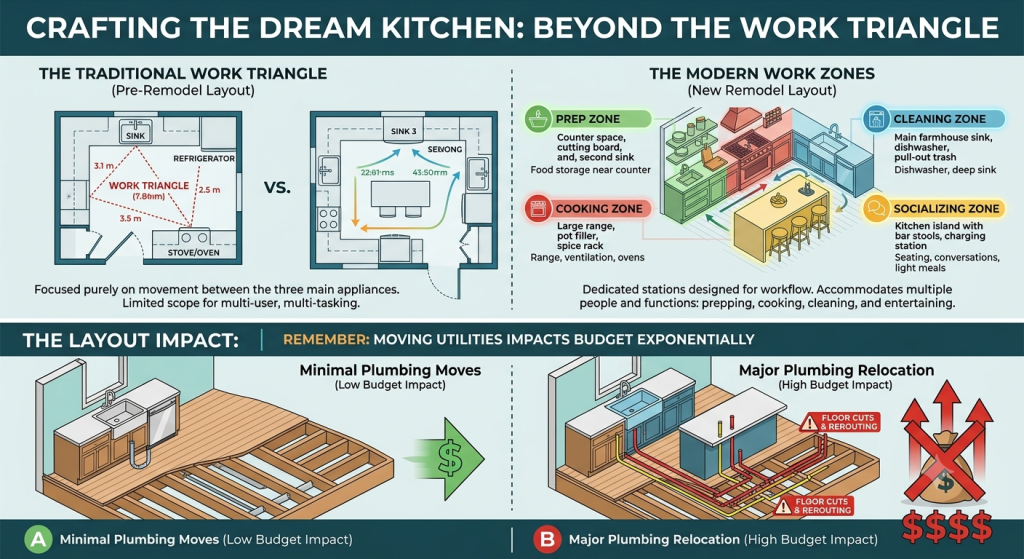
Let’s start with the big one. Kitchens are the number one requested remodel, and for good reason—they offer some of the highest returns on investment (ROI) and completely change how your family interacts daily.
The Layout is King
When homeowners look up best residential remodeling services for kitchen renovations near me, they’re usually thinking about quartz countertops and farmhouse sinks. But as a builder, my first thought is always the layout.
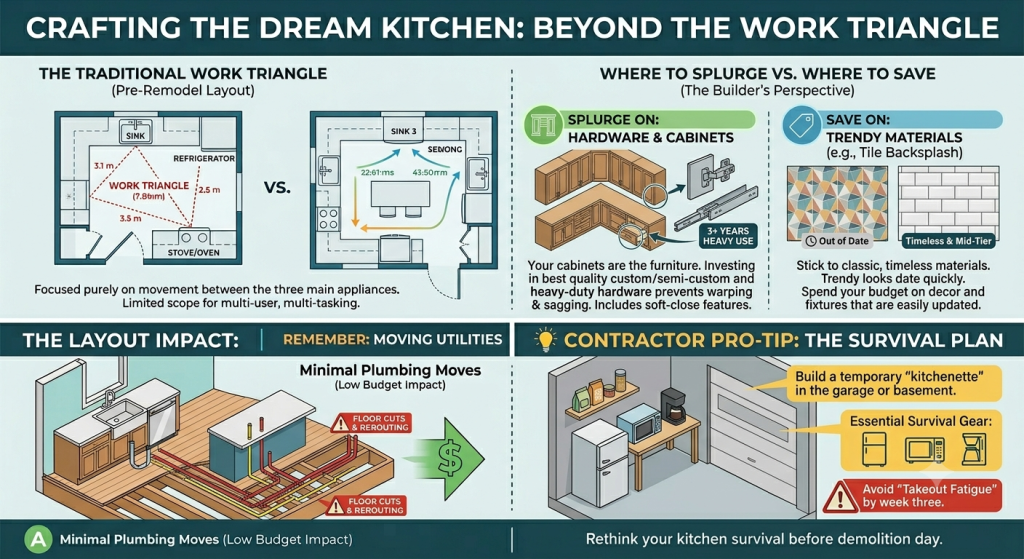
We used to talk about the “Work Triangle” (the distance between your sink, stove, and fridge). Today, we build in “Work Zones”—dedicated stations for prepping, cooking, cleaning, and socializing. If your remodel involves moving the kitchen sink across the room, remember that we have to cut through your floors to reroute plumbing and gas lines. That looks awesome on paper, but it exponentially impacts your budget.
Where to Splurge vs. Where to Save
- Splurge on Hardware and Cabinets: Your cabinets are the furniture of your kitchen. Cheap hinges and drawers will warp and sag within three years of heavy use. Buy the best custom or semi-custom soft-close cabinetry your budget allows.
- Save on Trendy Materials: That ultra-specific, brightly colored tile backsplash might look great on Instagram today, but it’ll date your kitchen by Tuesday. Stick to classic, mid-tier timeless materials and upgrade your decor instead.
💡 Contractor Pro-Tip: Build a temporary “kitchenette” in the garage or basement before demolition day. Factor a mini-fridge, a microwave, and a coffee maker into your survival plan, because you will get tired of takeout by week three.
The Open Floor Plan Revolution: Tearing Down Walls Safely
Everyone wants that bright, airy, modern look. When clients look into the best residential remodeling services for open floor plan conversions, they often think a sledgehammer is the primary tool required. Hold your horses.
Load-Bearing vs. Non-Load-Bearing
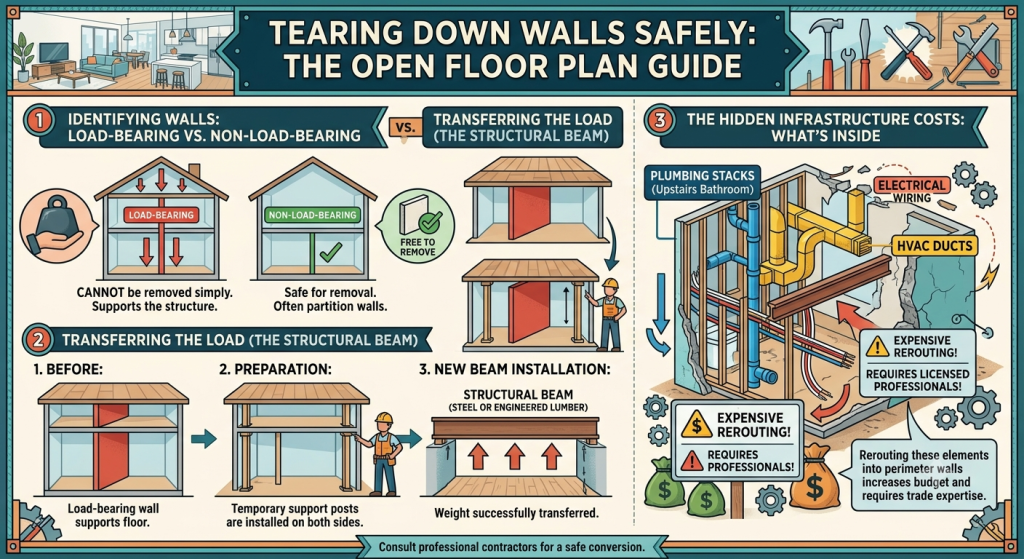
Before a single wall comes down, we have to determine what is holding up your roof. If it’s a load-bearing wall, we can’t just remove it; we have to transfer that weight to a structural beam (often heavy-duty engineered lumber or steel).
The Hidden Infrastructure Costs
The wall itself isn’t the expensive part. The real budget-killer is what’s inside the wall. Houses hide secrets: HVAC ducts, plumbing stacks from the upstairs bathroom, and bundles of electrical wiring. Rerouting these mechanical elements into the perimeter walls requires licensed trade professionals and precise coordination.
Breathing New Life into Old Bones: Historic Restorations
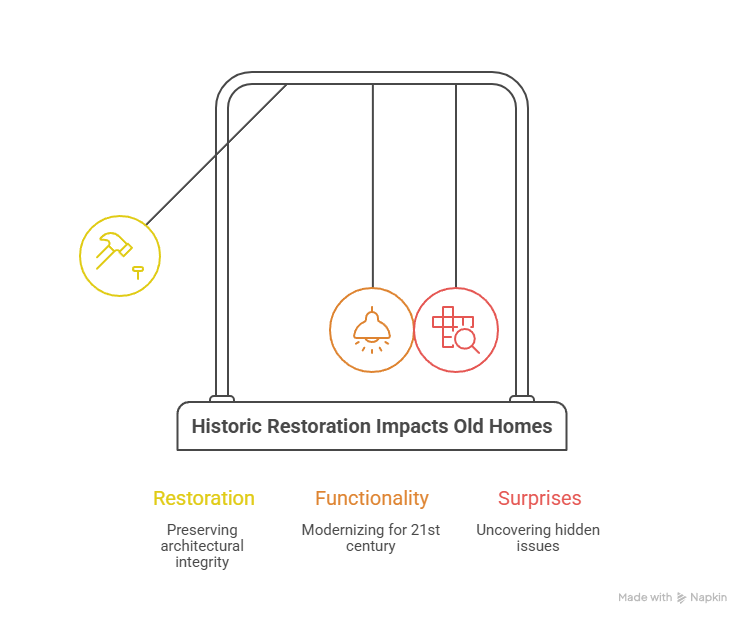
There is a massive difference between remodeling a suburban home built in 1995 and restoring a Craftsman, Victorian, or Mid-Century Modern home. If you own a piece of history, you should specifically seek out top-rated residential remodeling services specializing in historic home restorations.
Respecting the Architectural Integrity
A true historic restoration isn’t about making an old house look brand new; it’s about making it functional for the 21st century while honoring its past. This means replicating custom trim profiles, restoring original hardwood floors rather than replacing them with vinyl planks, and sourcing period-accurate hardware.
The Ghost in the Walls
When you open up a historic home, you will find surprises. Common culprits include:
- Knob-and-tube wiring or ungrounded electrical systems.
- Galvanized steel pipes that have corroded to the size of a straw on the inside.
- Lead paint and asbestos, which require specialized, certified mitigation.
Because of this, I always tell historic homeowners to double their emergency contingency fund. You never know what a DIYer from 1945 hid behind the plaster.
Maximizing Square Footage: Basements, Additions, and Baths
Sometimes you don’t need to change your current footprint; you just need to expand it or optimize what you already have.
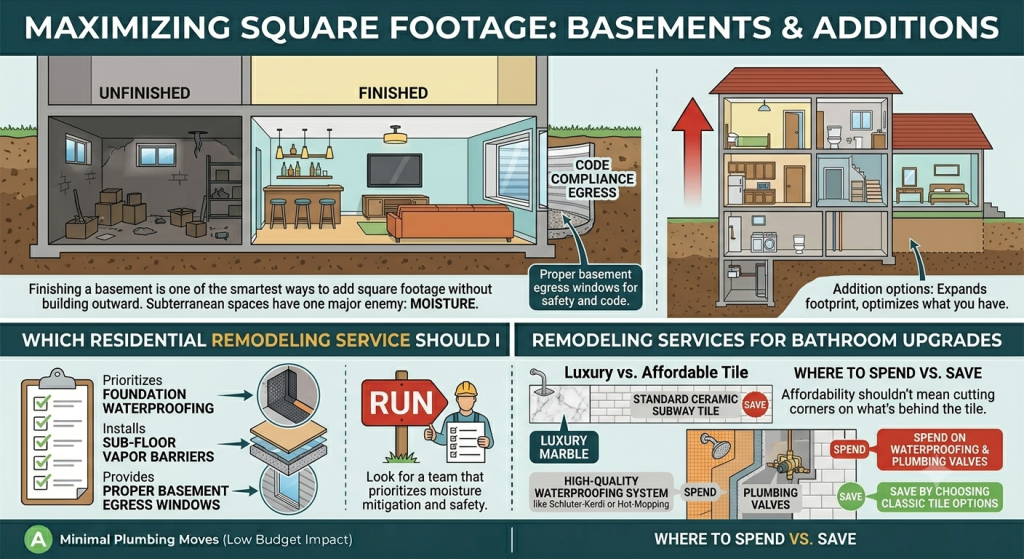
Which Residential Remodeling Service Should I Choose for Basement Finishing?
Finishing a basement is one of the smartest ways to add square footage without building outward. However, subterranean spaces have one major enemy: moisture.
When looking into which residential remodeling service should I choose for basement finishing, don’t just look for a good finish carpenter. Look for a team that prioritizes foundation waterproofing, sub-floor vapor barriers, and proper basement egress windows for safety and code compliance. If a contractor doesn’t mention moisture mitigation within the first ten minutes of looking at your basement, run.
Bathroom Upgrades on a Budget
If you are searching for affordable residential remodeling services for bathroom upgrades, remember that affordability shouldn’t mean cutting corners on what’s behind the tile.
A high-quality waterproofing system (like a Schluter-Kerdi membrane or hot-mopping) ensures that water stays in the shower and out of your framing. Spend money on the waterproofing and plumbing valves; save money by choosing standard ceramic subway tile, which looks elegant and costs a fraction of luxury marble.
The Paperwork and the Planet: Permits and Green Building
Let’s talk about the less glamorous side of building: rules, regulations, and materials.
Navigating Permits and Inspections
Never hire a contractor who asks you to pull the permits as an owner-builder, or who suggests working without them to “save time.”
You want to partner with residential remodeling services that handle permits and inspections. Pulling permits protects you. It ensures that an independent city inspector checks our work (framing, electrical, plumbing) to verify it’s safe and up to code. If you remodel without permits, you could face massive fines, be forced to tear down finished work, or face major issues when trying to sell your home down the road.
Going Green: Eco-Friendly Remodeling
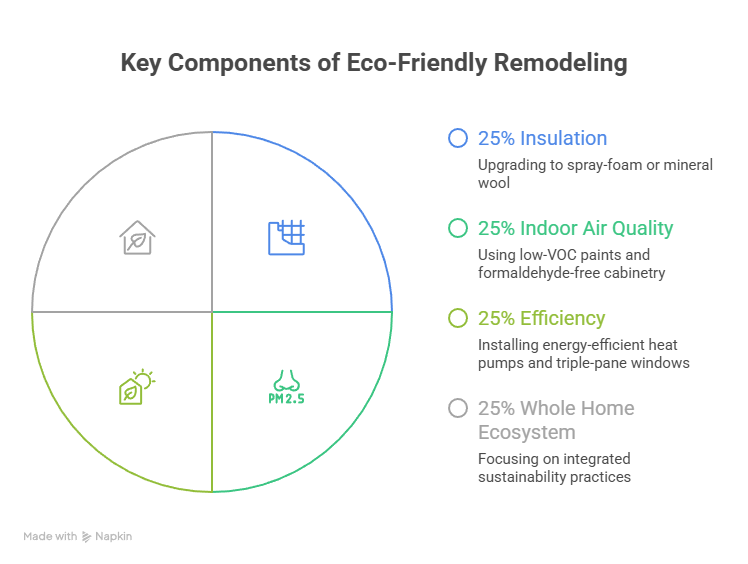
Sustainability isn’t just good for the earth; it’s great for your utility bills. When evaluating recommendations for residential remodeling services that offer eco-friendly materials, look for builders who focus on the whole home ecosystem:
- Insulation: Upgrading to spray-foam or mineral wool insulation during a gut remodel.
- Indoor Air Quality: Using low-VOC (volatile organic compound) paints and formaldehyde-free cabinetry.
- Efficiency: Installing energy-efficient heat pumps and triple-pane windows.
Navigating the Industry: Who to Hire and How to Pay
Residential Remodeling Services vs. General Contractors for Home Additions
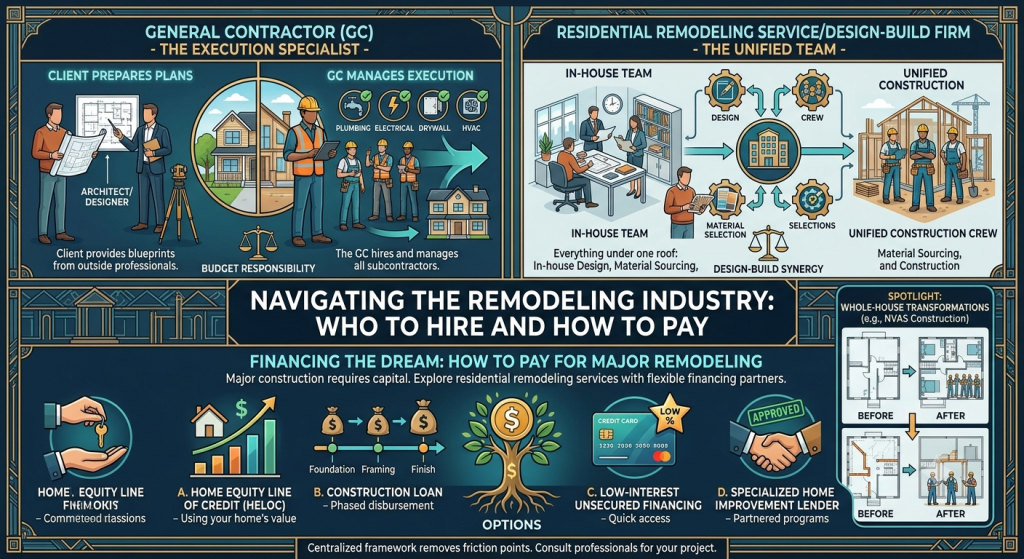
What’s the difference?
- A General Contractor (GC) is typically an execution specialist. You bring them blueprints created by an architect, and they manage the subcontractors (plumbers, electricians, drywallers) to build it.
- A specialized Residential Remodeling Service or Design-Build Firm handles everything under one roof. They have in-house designers who help you pick materials and sketch layouts, and then their construction crew builds it.
Spotlighting Whole-House Transformations: NVAS Construction
For major, multi-room architectural shifts, you need a brand that excels at full project orchestration. If you are weighing NVAS Construction vs other residential remodeling services for whole house remodeling, you’ll quickly see why specialized design-build teams stand out.
From day one, companies like NVAS Construction bring a centralized framework to the table, handling everything from structural wall tear-downs to modern material selections under a unified crew. This completely removes the classic friction point where an outside architect designs something that a separate field contractor physically can’t build within your budget constraint.
Financing the Dream
Major construction requires capital. Unless you’ve been saving cash for a decade, you’ll likely want to investigate residential remodeling services with flexible financing options. Many top-tier contractors partner with specialized home improvement lenders to offer Home Equity Lines of Credit (HELOCs), construction loans, or low-interest unsecured financing to help bridge the gap and keep your project moving forward without exhausting your personal savings.
Frequently Asked Questions (FAQs)
1. How long does a typical kitchen renovation take?
A standard cosmetic kitchen update can take 3 to 4 weeks, but a complete down-to-the-studs remodel involving structural changes, new layouts, and custom cabinetry typically takes anywhere from 6 to 12 weeks.
2. Can I live in my house during a whole-house remodel?
Technically, yes, but mentally… it’s tough. If you are doing a whole-house remodel or an open floor plan conversion, the dust, noise, and lack of utilities make living on-site incredibly stressful. If budget permits, we always recommend moving out temporarily during the heavy demolition and framing phases.
3. Why are contractor estimates so different for the same project?
Different contractors use different tiers of materials, rely on different qualities of subcontractors, and carry different levels of insurance and overhead. An incredibly low bid often means the contractor missed something in the scope of work, isn’t pulling permits, or uses uninsured labor. Always compare estimates line-by-line.
4. What is a change order, and how do I avoid them?
A change order is an amendment to the original contract for work that wasn’t specified in the initial scope (e.g., finding rotted wood under a shower floor). The best way to avoid them is thorough upfront planning and investigative work before signing the final contract.
Ready to Transform Your Home?
A home renovation is an investment in your quality of life, your family’s comfort, and your financial future. Don’t rush the planning phase. Take your time, vet your builders, look at their local portfolios, and make sure you hire a team that communicates clearly and respects your home.
Ready to take the first step? Contact our team today for an initial design consultation, and let’s turn that Pinterest board into real, solid square footage. Let’s build something incredible together!